
Homebush West NSW 2140

Checking that food-adjacent areas were cleaned by the agreed method in Homebush West

In a food-adjacent area the question is not whether a surface looks clean. A bench wiped with the wrong cloth and the wrong product looks identical to one cleaned correctly, which is why supervision on Homebush West sites has to check the method rather than the appearance.

In short

Checking method means looking at what was used and how, rather than at the finished surface. Which cloth went onto the bench, whether the product was the one specified, whether contact time was observed, whether the sequence separated raw and finished areas. None of that is visible afterwards, so it is checked during the shift or through the evidence the shift leaves behind.

Clean Best inspects the equipment, the chemistry and the soiled cloth evidence alongside the surfaces, and attends during a shift where a method question needs answering. Clean Best attends Homebush West premises from Seven Hills. Specialist food safety requirements remain the occupier's responsibility and are identified before any work is agreed.

Appearance is not evidence in these areas

A stainless bench wiped with a damp cloth and no product will look clean under normal lighting. So will a bench cleaned properly. The difference is entirely in what the surface carries afterwards, which nobody can see. That is why an inspection based on appearance provides almost no information in a food-adjacent area, and why relying on it produces a false sense of assurance that persists until something goes wrong.

The check therefore moves to the inputs. Was the correct product available and correctly diluted. Were the right cloths used and were they clean when they went onto the surface. Was the sequence followed so that a cloth from a bin area never reached a preparation bench. Those questions have observable answers, and together they say far more than a visual assessment of the bench itself.
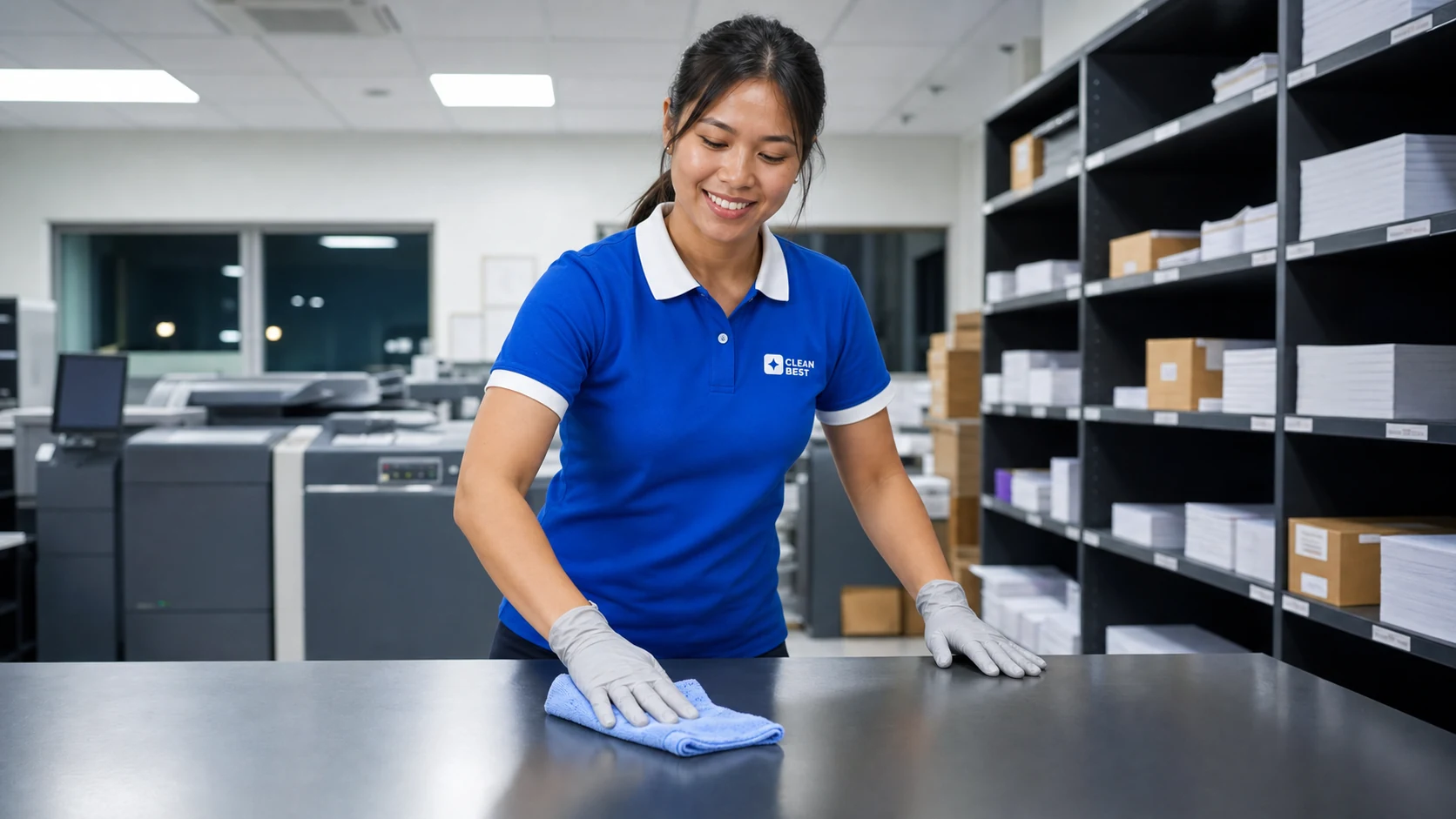
What the equipment shows after the shift

The soiled cloth bag is the most useful single piece of evidence available. If the site has three areas requiring separate cloth colours and the bag contains cloths of one colour, the separation did not happen regardless of what the surfaces look like. Counts matter too: a bag with two cloths in it after a shift covering six areas tells a clear story that no amount of inspection of the benches would reveal.

The chemical store adds to the picture. Product levels that have not moved since the previous visit indicate that something is not being used. A dosing dispenser that is empty or disconnected means dilution has been happening by eye. Machine and equipment condition shows whether care is being taken generally. Together these give a supervisor an accurate view of how the site has been worked over weeks.

Attending the shift when a question needs answering

Where the evidence raises a question, the supervisor attends during the shift rather than inspecting the next morning. Watching the actual sequence resolves in ten minutes what could otherwise be debated for a month. It also often reveals that the cleaner is doing something sensible in response to a site condition nobody mentioned, such as an area that is never released until late or a sink that produces no hot water.

That visit is arranged rather than sprung, in the sense that the supervisor decides to attend because there is a specific question to answer. It is not announced to the cleaner. The purpose is to see the ordinary working method, and a cleaner who knows a supervisor is coming will demonstrate the method they were taught rather than the one they use. The purpose is to see the ordinary working method rather than a demonstration of it.

Verifying method in a food-adjacent area

  • Soiled cloth evidence checked against the areas that should have been worked
  • Correct product available, correctly diluted and actually being consumed
  • Dosing equipment connected and functioning rather than bypassed
  • Cloth and equipment separation between raw, finished and waste areas
  • A supervisor attending during the shift when a question remains open
  • Specialist food safety requirements identified as the occupier's own
Clean Best supervisor inspecting facility cleaning in Blacktown NSW

Working in Homebush West and the Central West

Homebush West in the Central West is closely associated with markets, warehousing, retail and food-related businesses, which means a substantial number of premises there have areas where food is stored, handled or prepared adjacent to general commercial space. Cleaning in that setting carries consequences that are not visible on the surface afterwards, and a visual inspection provides very little assurance. Clean Best attends Homebush West from Seven Hills, and supervision on these sites is built around equipment evidence and shift attendance rather than around a morning walk of finished benches.

Questions about Homebush West

Can Clean Best clean food preparation areas?

Commercial cleaning of food-adjacent areas can be scoped, and suitability is confirmed at the walkthrough. Specialist requirements under a food safety programme, including anything requiring particular verification or certification, remain the occupier's responsibility. What is included and what is not is stated in writing before work begins, so there is no assumption of coverage that was never agreed.

How do you check the method was followed?

Through the evidence the shift leaves rather than through the appearance of the surfaces. Soiled cloth colours and counts, product consumption, dosing equipment condition and equipment separation all show what actually happened. Where a question remains, the supervisor attends during the shift and watches the sequence, which resolves in minutes what an inspection cannot resolve at all.

Why does a clean-looking bench not prove anything?

Because a bench wiped with a damp cloth and no product looks the same as one cleaned correctly. The difference is in what the surface carries afterwards, which is invisible. Inspecting appearance in these areas provides a false sense of assurance, which is more dangerous than no inspection because it stops anyone asking the questions that would find a problem.

Do you use separate equipment for food areas?

Yes, with colour separation so the rule is visible rather than remembered. Cloths and mop heads used in food-adjacent areas do not travel to waste or amenity areas and are not reused across them. Equipment is stored so the separation is physical, since a rule that depends on memory fails on the first night a relief cleaner attends.

What if we have our own cleaning requirements?

Tell us at the walkthrough and they are written into the site instruction rather than passed on verbally. That includes specified products, contact times, sequences and any area the crew must not enter. Written requirements survive a change of cleaner and give the supervisor something specific to verify, which a verbal briefing at induction does not.

Get a fixed written quote for Homebush West

Free walkthrough, scope in writing, price back within 24 hours.

Request a quote
Call nowEmail us