
Ultimo NSW 2007

Working an Ultimo building where student and staff use overlaps late

An education building rarely empties in a predictable way. Classes finish, study spaces fill, a lab is in use until eleven and somebody is always in the building. On an Ultimo campus the cleaning has to be delivered around people rather than after them.

In short

Where occupancy runs late and unevenly, the attendance is arranged around areas rather than around a closing time. Teaching spaces are worked as they release, study and common areas are worked in sections while occupied, and anything requiring an empty room is placed where the room is genuinely empty rather than where the timetable suggests it should be.

Clean Best builds the route from observed release patterns rather than from the published timetable, since the two rarely match. Clean Best attends Ultimo premises from Seven Hills. Areas that consistently cannot be reached are recorded and raised rather than absorbed into a shift that keeps falling short.

The timetable is not the occupancy

A room scheduled until six is frequently occupied until seven, because a class finishes and a discussion continues. A study space with no timetable at all fills from five and stays full. A lab may be in use well outside any published hours. Building a cleaning route from a timetable produces a shift that collides with people in half the rooms and finds others empty for hours. Rooms empty for hours are as wasteful as rooms that cannot be entered at all.

The route is therefore built from observation over the first few weeks and corrected as patterns emerge. That is a mobilisation task and an ongoing one, since teaching patterns change each session. The crew reporting when a room's pattern has shifted is the mechanism, because nobody else in the building is watching occupancy from the perspective of somebody trying to clean it. Nobody else in the building watches occupancy from that perspective.
Working alongside students and staff

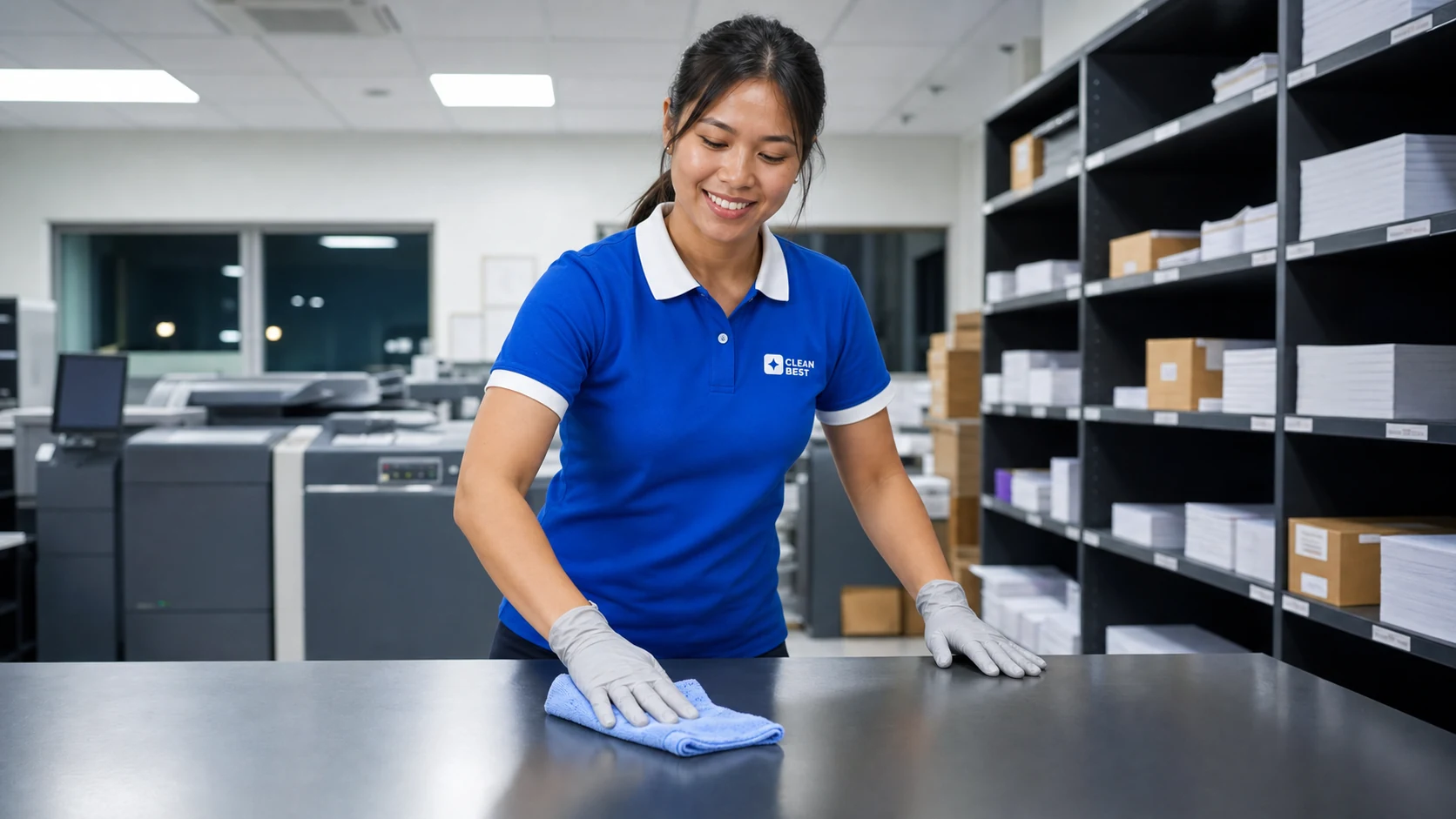
Common areas and study spaces will be occupied for most of the attendance, so the work happens around people: sectioning so a dry route always exists, quieter equipment where people are working, and no wet work across a route somebody needs. Waste and amenity servicing can proceed throughout and are the most valuable things to keep on schedule, since those degrade fastest under continuous use. Those are also the areas that degrade fastest under continuous evening use.

Conduct matters in this setting as much as method. A cleaner working among students in the evening is a visible presence in a building where people are studying, and how they work affects how the building feels. Compact equipment, giving way to people, and avoiding disruptive activity near anyone concentrating are all part of what makes the arrangement acceptable. How the crew works is part of how the building feels to people studying in it.

Recording what cannot be reached

A teaching space that is never released before the crew leaves is not being cleaned, and recording it as inaccessible with times is the only way that becomes visible. Over a session the record shows which rooms and which evenings are consistently unreachable, which is a timetabling matter that the institution can address in a way the cleaning contractor cannot. The institution can address a timetabling collision in a way a contractor cannot.

The options are usually straightforward once the pattern is visible: a different attendance time for that area, a change to a room booking, or accepting that the room is serviced on alternate days. What is not workable is a scope that includes rooms the attendance can never reach, because the shortfall then reads as a cleaning failure rather than as an access one. A shortfall then reads as a cleaning failure rather than as an access one.

Cleaning around late and uneven occupancy

  • The route built from observed release patterns, not the published timetable
  • Crew reports of shifted patterns used to correct the route each session
  • Common and study areas sectioned so a dry route always exists
  • Waste and amenity servicing kept on schedule throughout the attendance
  • Quieter equipment and compact working where people are studying
  • Consistently unreachable rooms recorded with times and raised
Clean Best supervisor inspecting facility cleaning in Blacktown NSW

Working in Ultimo and the Inner City

Ultimo in the Inner City holds education, technology, office and mixed-use premises, with a substantial teaching and study population that keeps buildings occupied well into the evening. Occupancy in that setting follows sessions and study habits rather than a published closing time, so a cleaning route built from a timetable will collide with people in half the rooms it visits. Clean Best attends Ultimo premises from Seven Hills, and the route is built from what the crew observes over the first weeks and corrected as each session's patterns change.

Questions about Ultimo

Can cleaning happen while students are in the building?

Yes, and on a teaching site there is rarely an alternative. Common areas and study spaces are sectioned so a dry route always exists, quieter equipment is used where people are working, and waste and amenity servicing proceed throughout. Work requiring an empty room is placed where the room is genuinely empty rather than where a timetable suggests it will be. Which areas fall into each category is recorded so a relief cleaner works the same way.

Why not just follow the timetable?

Because the timetable describes bookings rather than occupancy. A room scheduled until six is often occupied until seven, and a study space with no booking at all fills from five and stays full. A route built from the timetable collides with people in half the rooms and finds others empty for hours. Observation over the first few weeks produces a route that actually fits the building.

What happens to rooms that are always occupied?

They are recorded as inaccessible with times, which over a session shows exactly which rooms and evenings are consistently unreachable. That is a timetabling matter your institution can address in a way a cleaning contractor cannot. The options are usually a different attendance time, a booking change, or servicing on alternate days. Recording it with times is what makes the pattern visible over a full session.

How does the route stay current as sessions change?

The crew reports when a room's pattern has shifted, and the route is corrected. Nobody else in the building is watching occupancy from the perspective of somebody trying to clean it, so that observation is the practical mechanism. It is treated as an ongoing task rather than something settled once at mobilisation. The route is updated in the site instruction so the change survives a cleaner substitution.

Do you handle laboratories or specialist spaces?

Commercial cleaning of those areas can be scoped, with suitability confirmed at the walkthrough and any restriction, exclusion or specific method written into the site instruction. Specialist decontamination and anything under a laboratory's own safety programme remain the institution's responsibility, and that boundary is stated in writing before work begins. Any specific product, method or exclusion for those areas is recorded rather than passed on verbally.

Get a fixed written quote for Ultimo

Free walkthrough, scope in writing, price back within 24 hours.

Request a quote
Call nowEmail us